Contents:
- Why Basket Flower Arrangements Deserve More Credit
- The Foundations of Basket Flower Arrangement: What Beginners Need to Know
- Floral Foam: The Hidden Architecture
- Basket Selection and Sizing
- Foam-Free Alternatives: The Water Tube Method
- Basket Flower Arrangement Ideas by Occasion
- Birthday Basket Arrangements
- Sympathy and Comfort Basket Arrangements
- Get-Well Basket Arrangements
- New Baby Basket Arrangements
- Wedding and Event Basket Arrangements
- Color Theory for Basket Flower Arrangements
- The Three-Color Structure
- Seasonal Color Expectations
- Regional Style Differences in Basket Arrangements
- Northeast: Structured Elegance
- South: Romance and Abundance
- West Coast: Loose, Natural, and Botanical
- Intermediate Design Techniques for Basket Flower Arrangements
- Working in Layers: Building Visual Depth
- The Rule of Odd Numbers
- Textural Contrast as a Design Element
- Controlling Fragrance Levels
- Advanced Nuances: What Separates Professional Basket Arrangements
- Negative Space as a Design Tool
- Focal Point Placement and the Golden Ratio
- Mechanics That Make Delivery Possible
- Water Management for Multi-Day Freshness
- Common Mistakes to Avoid in Basket Flower Arrangements
- Choosing Flowers That Peak at Different Times
- Under-Soaking the Foam
- Ignoring Proportion Between Basket and Arrangement
- Clustering All the Color Together
- Forgetting the Back of the Arrangement
- Ordering From Florists Without Delivery Expertise
- What to Look for When Ordering Flower Basket Delivery
- Transparency About Flower Sourcing
- Custom Design Capability
- Reliable Same-Day and Next-Day Delivery
- Visual Portfolio Evidence
- Caring for a Delivered Basket Arrangement
- Common Mistakes to Avoid Section
There’s a persistent myth that basket flower arrangements are somehow less elegant than vase arrangements — that baskets belong at hospital bedsides or church potlucks, not at upscale celebrations or meaningful personal moments. That myth is wrong, and this guide is going to dismantle it completely. Basket arrangements are one of the most versatile, structurally interesting, and emotionally resonant ways to present flowers. When done well, a flower basket delivers in ways a standard vase simply cannot.
This guide covers everything from the foundational mechanics of basket flower arrangement ideas to advanced design choices that professional florists use. You’ll learn why baskets work so well for certain occasions, how regional preferences across the Northeast, South, and West Coast influence style decisions, what mistakes undermine even beautiful flower selections, and how a florist like Flowers Central Jersey approaches basket design differently from generic mass-market options. By the end, you’ll know exactly how to choose, customize, and order a basket arrangement that genuinely impresses.
Why Basket Flower Arrangements Deserve More Credit
Baskets solve a problem that vases cannot: they’re self-contained. No water to spill, no fragile glass to worry about, no surface damage when the arrangement is moved from a car seat to a table to a windowsill. That practical advantage matters enormously for delivery, for gifting at events, and for any setting where a glass vase would feel precarious.
Beyond logistics, baskets provide a structural platform that encourages more creative, dimensional design. A skilled florist working with a basket can build height at the center, cascade blooms toward the edges, tuck textural greenery at multiple depths, and create something that reads as lush and abundant rather than simply tall and vertical. The rim of the basket frames the arrangement like a painting frame — it creates a visual boundary that makes the composition feel intentional.
Sentimentally, baskets carry associations that vases don’t. They read as warm, generous, handcrafted — even when they arrive through professional delivery. That warmth makes them particularly well-suited for sympathy and comfort situations, new baby arrivals, get-well occasions, and any moment when the emotional register needs to be gentle rather than dramatic. A stunning basket of flowers delivery communicates care in a way that feels genuinely personal.
The Foundations of Basket Flower Arrangement: What Beginners Need to Know
Before exploring design ideas, understanding the physical mechanics of basket arrangements prevents most beginner mistakes. Unlike vase arrangements where stems sit in water, basket arrangements typically use floral foam (also called oasis) as the structural base. This changes everything about how you work.
Floral Foam: The Hidden Architecture
Floral foam is a dense, porous material that absorbs water and holds cut stems securely in any direction. A block of foam soaked in water before arrangement provides both hydration and stability for the stems. The foam sits inside the basket, usually in a waterproof liner or plastic tray to prevent moisture from damaging the basket material.
Properly soaked foam — submerged in water until it sinks on its own weight, typically 60 to 90 seconds for a standard block — can hold enough water to keep flowers fresh for five to seven days without additional watering. Under-soaked foam, which some beginners force underwater to speed the process, retains dry air pockets at its core and fails to hydrate properly. That single mistake cuts the arrangement’s life by days.
The foam block should sit slightly above the basket rim — typically by half an inch to an inch — so stems can be inserted at downward angles toward the sides and front, creating the rounded, overflowing look that makes basket arrangements so visually appealing. Foam that sits below the rim forces every stem straight upward, which produces a stiff, choppy composition.
Basket Selection and Sizing
Baskets come in an enormous range of materials, shapes, and sizes. Wicker and woven willow are the classic choices, offering a natural, warm aesthetic. Handled baskets provide visual symmetry and a practical carrying point. Low, wide baskets (sometimes called garden baskets or trug baskets) allow sprawling, horizontal compositions with a very different feel from tall, deep baskets.
Sizing matters practically: a basket that’s too large for the foam block and flower quantity will look sparse and underfilled. A useful rule of thumb is that the finished arrangement should be roughly 1.5 times the height of the basket and 1.5 to 2 times the width. A basket with an 8-inch opening looks best with an arrangement that spans 12 to 16 inches wide at its fullest point.
For a standard gift arrangement — the kind you’d order for a birthday or sympathy occasion — a handled basket measuring 10 to 12 inches in width is a versatile sweet spot. It’s substantial enough to feel generous without overwhelming a typical tabletop or windowsill.
Foam-Free Alternatives: The Water Tube Method
Some florists, particularly those focused on sustainability, have moved toward foam-free basket arrangements. In these designs, individual flower stems sit in small plastic water tubes (sometimes called aqua picks) that hold a small reservoir of water for each stem. The tubes are then anchored into a base of moss, crumpled kraft paper, or a mesh grid secured across the basket opening.
The foam-free approach works well for single-variety arrangements or loose, garden-style compositions. It requires more individual attention to each stem and typically produces a slightly more relaxed, less structured look. For buyers ordering basket flower arrangements for delivery, traditional foam-based designs tend to travel better, as the foam provides stability that loose tubes cannot entirely replicate.
Basket Flower Arrangement Ideas by Occasion
The most useful way to think about basket arrangements is by occasion, because occasion shapes appropriate color palette, flower selection, size, and structural style simultaneously. Here’s how skilled florists approach each major category.
Birthday Basket Arrangements
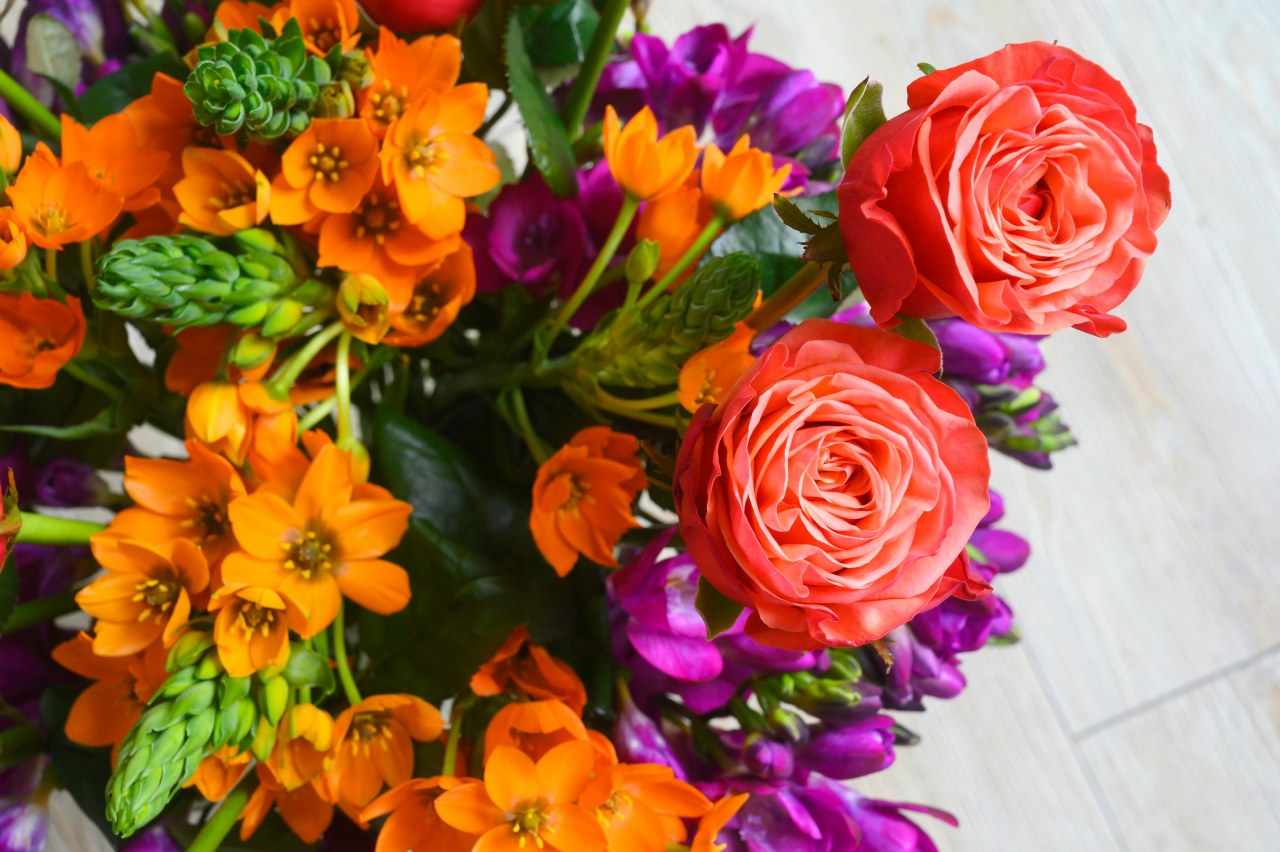
Birthday arrangements live or die on energy. The goal is visual excitement — something that reads as celebratory the moment it enters the room. This typically means saturated, warm colors: coral and orange roses mixed with yellow sunflowers and hot pink gerbera daisies, for example. Or rich jewel tones — deep purple lisianthus, burgundy roses, and bright magenta spray carnations — for a more dramatic take.
Height plays a role here too. Birthday baskets often benefit from including one or two tall, statement elements — larkspur spires, tall snapdragons, or branches of hypericum berries — that add vertical energy above the main mass of blooms. A handled basket with this kind of verticality conveys abundance and celebration at a glance.
For specific age milestones, florists sometimes match flower count or color symbolism to the occasion. Twenty-five red roses for a 25th birthday, for instance, or a mix of flowers in the recipient’s birth month’s traditional color palette. These personalized touches elevate a basket from a generic gift to something genuinely thoughtful.
Sympathy and Comfort Basket Arrangements
Sympathy arrangements require almost the opposite approach from birthday designs. Soft, cool, desaturated palettes — white, cream, pale lavender, soft peach — communicate gentleness and calm. Rounded, low arrangements sit better than tall, dramatic ones. The mood should be quiet rather than celebratory.
White lilies remain a classic sympathy choice across most of the country, though preferences vary significantly by region (more on that below). White roses mixed with eucalyptus and soft blue delphinium create a restrained, elegant composition that works well for both religious and secular contexts. Muted foliage like dusty miller or lamb’s ear adds visual texture without adding color intensity.
Sympathy baskets benefit from simplicity. Overloaded, complex arrangements with many competing elements can feel visually busy in a grief context. A well-designed sympathy basket often uses fewer distinct flower types — three to four varieties at most — and lets the quality and freshness of those blooms carry the arrangement.
Get-Well Basket Arrangements
Get-well arrangements need to work in a hospital room or bedroom, which means accounting for scent sensitivity (some patients, particularly those undergoing chemotherapy, cannot tolerate strong floral fragrances), practical space limitations, and the psychological function of color in a recovery context.
Cheerful, uplifting colors — yellow, soft orange, peach, bright green — support a sense of energy and optimism without the intensity of red or deep purple. Sunflowers are a perennial favorite for get-well arrangements because they’re visually joyful, relatively long-lasting, and unscented. Mixed daisy arrangements — gerbera daisies in multiple colors with some cushion poms and greenery — strike the same note.
For hospital delivery specifically, low-maintenance arrangements matter. Patients and their visitors shouldn’t have to manage complex care instructions. A well-soaked floral foam basket arrangement requires only a small amount of water added every two to three days, which makes it far more practical than a standard vase arrangement in a clinical setting.
New Baby Basket Arrangements
Baby arrangements lean toward soft pastels — the traditional pink for girls, blue for boys, or gender-neutral yellows, greens, and whites for an inclusive approach. Garden-style arrangements with roses, ranunculus, stock flowers, and sweet pea have a soft, romantic quality that reads beautifully in this context.
Some florists add whimsical elements to baby baskets: a small plush animal nestled among the blooms, baby’s breath woven throughout, or a decorative ribbon in complementary colors. FlowersCNJ takes this kind of customization seriously — their team asks about the recipient’s aesthetic preferences and the family’s nursery palette to make sure the arrangement feels intentional rather than generic.
Wedding and Event Basket Arrangements
Basket arrangements at weddings and events serve both decorative and atmospheric functions. Flower girl baskets — small, handled baskets filled with petals for scattering — are a classic wedding element. Reception centerpiece baskets, particularly for garden-style or rustic-themed weddings, create a warm, abundant look that formal vase arrangements sometimes can’t match.
Event baskets for corporate gatherings or milestone celebrations often follow the organization’s color palette or brand identity. A company celebrating its anniversary might commission a basket arrangement in its signature colors. This kind of customization requires close communication between the florist and the client, and it’s exactly the kind of specialized work where FlowersCNJ’s design consultation process makes a real difference.
Color Theory for Basket Flower Arrangements
Color is the single most powerful variable in any flower arrangement, and it rewards deliberate thinking. Most amateur arrangements fall into one of two traps: choosing too many colors without a unifying principle, or defaulting to monochrome when a small amount of contrast would elevate the design significantly.
The Three-Color Structure
Professional florists typically work with a three-color structure: a dominant color (comprising roughly 50–60% of the visual mass), a secondary color (25–30%), and an accent color (10–20%). This proportion creates visual cohesion while avoiding monotony.
Example: A summer birthday basket might use soft orange as the dominant color (garden roses, ranunculus), coral as the secondary color (spray roses, tulips), and deep burgundy as the accent (a handful of astrantia or a spray of hypericum berries). That accent color anchors the warm palette and adds visual depth without competing with the main tones.
Seasonal Color Expectations
Color availability follows the seasons, and working with seasonal blooms rather than against them produces better results at better prices. Spring basket arrangements naturally lend themselves to soft yellows, lavenders, and pinks — tulips, hyacinths, daffodils, and peonies hit their peak availability and quality in April and May. Summer baskets can embrace bolder, more saturated palettes: sunflowers, zinnias, dahlias, and tropical varieties thrive in the summer heat and availability windows.
Fall basket arrangements are a particular strength at FlowersCNJ, where the team leans into the season’s extraordinary palette — deep oranges, rusts, burgundies, and warm golds using dahlias, marigolds, celosia, and garden roses. Winter arrangements shift toward refined white-and-green combinations with occasional red or deep crimson for warmth, using amaryllis, white roses, pine, and berried branches.
Regional Style Differences in Basket Arrangements
Flower arrangement aesthetics in the United States vary meaningfully by region, shaped by local culture, garden traditions, climate, and the dominant aesthetic preferences of each area. If you’re ordering a basket arrangement and you know the recipient’s regional sensibility, these differences are worth understanding.
Northeast: Structured Elegance
The Northeast — particularly New York, New Jersey, Connecticut, and Massachusetts — tends to favor arrangements that balance structure with abundance. Clean lines, premium flower varieties (garden roses over standard hybrid teas, for instance), and a preference for deep, sophisticated color palettes characterize this regional sensibility. White and green combinations are frequently requested for formal occasions. Lush but controlled. A well-designed Northeast basket arrangement looks purposeful at every angle.
Central Jersey, where FlowersCNJ operates, reflects this regional aesthetic clearly. The clientele tends to be discerning about flower quality and presentation detail — stems must be fresh, proportions must be considered, and the overall design should feel curated rather than assembled. That expectation drives the standard of work you see in every arrangement that leaves their shop.
South: Romance and Abundance
Southern flower aesthetic leans heavily into romantic abundance — arrangements that overflow their containers, cascade dramatically, and use lush textural elements like gardenias, magnolia leaves, muscari, and heavily perfumed blooms. Color palettes tend toward soft, warm, and somewhat nostalgic: blush, cream, peach, and soft gold. Garden party aesthetics and a connection to traditional Southern floral iconography (gardenias, azaleas, camellias) influence the regional style strongly.
Sympathy arrangements in the South often run larger and more elaborate than in other regions — it’s culturally expected to send substantial floral expressions to memorial services, and undersized arrangements can read as insufficient. A florist shipping to a Southern recipient should account for this by defaulting to larger sizes and more voluminous designs.
West Coast: Loose, Natural, and Botanical
West Coast flower aesthetics — particularly in California, Oregon, and Washington — have been heavily shaped by the natural garden movement and by the influence of Scandinavian and Japanese design sensibilities. The characteristic West Coast basket arrangement looks loose, slightly wild, and botanically focused. It might include unusual foliage varieties (eucalyptus, ferns, bupleurum), single-stem specialty varieties like protea or Japanese anemone, and a deliberately imperfect, gathered-from-a-garden quality.
Color palettes on the West Coast lean toward muted, natural tones: dusty pink, sage green, terracotta, and warm white rather than saturated, vibrant hues. Highly formal or tightly structured arrangements can feel culturally misaligned with this aesthetic. If your recipient is based in the Pacific Northwest or California and has a contemporary, nature-forward sensibility, a loose garden-style basket is almost certainly the right direction.
Intermediate Design Techniques for Basket Flower Arrangements
Once the basics are solid, a handful of intermediate techniques separate competent basket arrangements from genuinely impressive ones.
Working in Layers: Building Visual Depth
The most common visual flaw in amateur basket arrangements is flatness — all the blooms sit at roughly the same height, creating a uniform surface rather than a dynamic composition. Professional florists avoid this by working in three visual layers: a background layer of taller, linear materials (snapdragons, liatris, tall foliage); a middle layer of the primary mass flowers at mid-height (roses, carnations, gerbera daisies); and a foreground layer of lower-sitting blooms and cascading elements that spill toward and over the basket rim.
Building these layers sequentially — background first, then middle, then foreground — is far easier than trying to insert all three levels simultaneously. Start with your tallest materials placed at the rear-center of the foam block, then work forward and downward. The last elements placed should be those that cascade toward the viewer.
The Rule of Odd Numbers
Groupings of odd numbers — three, five, seven — look more natural than even groupings in floral design, just as they do in garden planting and interior styling. Three roses clustered together look organic; four feel symmetrical and rigid. When working with a primary focal flower, aim for odd-number groupings placed at varying heights and positions within the arrangement rather than evenly spaced around the basket.
Textural Contrast as a Design Element
Texture — the visual and tactile surface quality of stems, leaves, and flowers — is as important as color in creating visual interest. A basket arrangement composed entirely of smooth, round flowers like roses and carnations can look monotonous despite strong color choices. Adding textural contrast through spiky or feathery elements (celosia, astilbe, grasses), velvet-textured blooms (cockscomb, black-eyed Susans), and varied foliage (glossy gardenia leaves alongside matte eucalyptus) creates the visual complexity that makes an arrangement compelling at close range.
The florists at FlowersCNJ are particularly attentive to texture, often incorporating unexpected textural elements — dried seed pods, berry-laden branches, or structural air plants — that give arrangements a distinctive signature without competing with the primary flowers.
Controlling Fragrance Levels
Fragrance is part of a flower arrangement’s total sensory impact, and it can be adjusted through variety selection. If the arrangement is for a sensitive space — a hospital room, an office, a home with allergy-prone residents — choosing low-fragrance varieties matters. Roses are highly variable: some varieties like Juliet garden roses are powerfully scented, while many hybrid teas bred for visual impact produce very little scent. Lilies are among the most potent-scented cut flowers; Asiatic lilies are significantly less fragrant than Oriental lilies and make a practical substitution.
For occasions where scent is part of the gift — a romantic anniversary arrangement, a welcoming home basket, or a spa-like wellness delivery — intentionally selecting for fragrance creates an additional sensory dimension. A mix of scented stock flowers, fragrant roses like shop roses here, and a few sprigs of fresh lavender delivers a scent experience as memorable as the visual one.
Advanced Nuances: What Separates Professional Basket Arrangements
At the professional level, basket flower arrangement becomes a study in restraint, proportion, and the relationship between the arrangement and its context. These nuances are worth understanding even if you’re ordering rather than arranging, because they help you recognize quality and communicate your vision more clearly to a florist.
Negative Space as a Design Tool
Beginning arrangers fill every inch of visible foam. Professionals use negative space — empty areas within the composition — deliberately. A gap between flower clusters lets each group read distinctly rather than merging into visual noise. A low, open section near the front of a basket draws the eye inward and creates a sense of depth. An area of simple greenery between two dense flower groups acts as a visual rest, making the blooms adjacent to it read more vividly by contrast.
This principle runs counter to the instinct to maximize coverage, which is why most DIY arrangements look overloaded. The goal isn’t to use every available flower — it’s to make each flower in the arrangement as visible and impactful as possible.
Focal Point Placement and the Golden Ratio
Every strong arrangement has a focal point — a spot where the eye lands first and naturally returns to. In basket arrangements, this focal point is typically the largest, most visually compelling bloom or cluster, placed at roughly one-third of the way from the front edge of the basket and elevated slightly above the surrounding flowers.
The golden ratio (approximately 1:1.618) appears repeatedly in naturally appealing visual compositions, and flower arrangements are no exception. A basket arrangement with its focal point placed at the golden ratio intersection rather than dead center tends to feel more dynamic and alive. This is a subtlety most viewers don’t consciously register, but they respond to it — the arrangement feels right rather than flat or contrived.
Mechanics That Make Delivery Possible
A beautiful basket arrangement that arrives crushed or displaced is a failure regardless of its design. Professional florists who specialize in delivery — like FlowersCNJ, which handles same-day and next-day basket of flowers delivery throughout Central Jersey — pay close attention to the structural integrity of arrangements in transit.
This means using appropriate foam density for the weight of the flowers, securing taller elements with additional anchor points rather than relying on foam alone for stability, and leaving enough clearance at the top of the arrangement to avoid damage during packaging. Protective sleeves, tissue supports, and correctly sized boxes complete the system. An arrangement that travels well is an arrangement that was designed with delivery in mind from the first stem placed.
Water Management for Multi-Day Freshness
Basket arrangements require different water management than vase arrangements because the foam, not the water in the vase, is doing the hydration work. Adding water to a foam-based basket arrangement means pouring water directly onto the foam — about half a cup every two to three days — rather than filling a visible water reservoir. The foam absorbs this water and continues supplying the stems.
Flower longevity in a well-constructed basket arrangement: roses and gerbera daisies typically hold beautifully for five to eight days; lilies and alstroemeria can last seven to ten days; chrysanthemums and carnations can push ten to fourteen days if the arrangement stays cool. Knowing these different lifespans helps florists position longer-lasting varieties strategically — they hold the arrangement together as shorter-lived focal flowers age naturally.
Common Mistakes to Avoid in Basket Flower Arrangements
Understanding what goes wrong is as useful as knowing what to do right. These are the mistakes that most frequently undermine basket arrangements — whether you’re arranging yourself or evaluating what you’re being sent.
Choosing Flowers That Peak at Different Times
Some florists — particularly volume-focused operations — build basket arrangements by grabbing whatever’s available without considering the peak timing of different varieties. The result is an arrangement that looks stunning for two days, then falls apart dramatically as the fastest-aging flowers collapse while others are just opening. A tight rosebud and a fully open lily sitting side by side may look appealing initially, but that lily will be dropping petals before the rosebud even opens.
The professional approach is to either match flowers with similar peak timing or to sequence varieties deliberately — including some flowers specifically to hold the arrangement together in its later days. This requires genuine expertise and attention to detail that mass-market operations often skip.
Under-Soaking the Foam
Already touched on briefly, this is worth its own section because it’s so damaging and so common. Foam that hasn’t been soaked correctly looks identical to properly soaked foam until two or three days into the arrangement’s life, when flowers begin wilting despite appearing to be in good condition otherwise. By then, the damage is done. Proper foam soaking — passive submersion, no pressing or forcing — is the single most important preparation step for any foam-based basket arrangement.
Ignoring Proportion Between Basket and Arrangement
A large basket with a sparse, flat arrangement looks unfinished and sad, regardless of flower quality. A small basket crammed with blooms looks chaotic and overwrought. The 1.5x height and 1.5–2x width rule above holds as a reliable starting guide. Beyond the mechanics, proportional awareness means stepping back and evaluating the arrangement as a whole at intervals during construction, not just looking at individual stems in isolation.
Clustering All the Color Together
Color distribution is a frequent beginner mistake: all the red flowers end up in one quadrant, all the yellow in another, and the result looks like a color-sorted sample board rather than an arrangement. Skilled florists distribute each color throughout the composition so that every angle of the basket shows the full palette. Groupings of the same variety in threes add texture and rhythm; randomly scattered single stems of many varieties create visual noise.
Forgetting the Back of the Arrangement
Basket arrangements often look beautiful from the front and completely bare from behind. This only matters when the arrangement will be seen from multiple angles — but that’s the case for any centerpiece, any arrangement on a dining table, or any gift basket placed where people will walk around it. Florists building for multi-angle visibility use shorter, finished materials at the rear and ensure foliage coverage extends to the back of the foam block.
Ordering From Florists Without Delivery Expertise
A basket arrangement requires different packaging and transport considerations than a standard bouquet or vase. Florists without established delivery systems may deliver beautiful in-shop arrangements that arrive displaced, damaged, or dried out. Asking specifically about how arrangements are packaged for transport — and choosing florists with track records in delivery — protects your investment and the recipient’s experience.
What to Look for When Ordering Flower Basket Delivery
For most people reading this guide, the goal isn’t to become a professional florist — it’s to order a basket arrangement that genuinely impresses. Here’s what to evaluate when choosing where to order.
Transparency About Flower Sourcing
Fresh flowers start with fresh sourcing. Florists who source from local farms or receive direct-import flowers multiple times per week have a freshness advantage over those who rely on weekly wholesale orders. Ask when the flowers were received, or simply look at reviews that mention flower longevity — customers who receive arrangements that last a week or more are a reliable signal of fresh sourcing.
Custom Design Capability
A florist who can actually customize an arrangement — who asks about the recipient’s preferences, the occasion’s tone, and the setting where the arrangement will live — is operating at a different level than one who offers only pre-set product categories. FlowersCNJ takes a consultation-forward approach to significant orders, particularly for weddings, events, and personalized gifts, that results in arrangements aligned with what the customer actually envisioned rather than a generic version of the category.
Reliable Same-Day and Next-Day Delivery
Delivery timing affects flower freshness directly. An arrangement cut and arranged in the morning, delivered in the afternoon, and placed in its location by evening is starting its display life in the best possible condition. Same-day delivery windows matter for occasions where last-minute gifting is necessary, and next-day precision matters for milestone celebrations where timing is specific. FlowersCNJ’s delivery coverage throughout Central Jersey provides that kind of timing reliability, which is part of why their flower basket delivery service maintains the quality level that customers report.
Visual Portfolio Evidence
Look at actual photos of the florist’s basket arrangements, not just stock imagery or placeholder product photos. A real portfolio shows you the finish quality, size accuracy, and design sensibility that you’ll actually receive. A florist confident enough to show their real work openly is demonstrating the same confidence you want behind the arrangement they’re making for your special occasion.
Caring for a Delivered Basket Arrangement
Once a basket arrangement arrives, a few simple practices extend its life meaningfully. Place it away from direct sunlight, heating vents, and drafts. Add roughly half a cup of room-temperature water directly to the foam every two to three days — tip the basket slightly to direct the water toward the center of the foam block rather than letting it run off the edges. Remove individual flowers as they naturally fade rather than letting them sit and contribute bacteria to the foam.
If any stems become loose as the foam shifts slightly with repeated watering, re-insert them at a slightly different angle rather than the same original hole. New punctures in foam grip better than enlarged existing ones.
Keep the arrangement at 65–72°F ambient temperature when possible, and consider moving it to a cooler room at night. That 8–10°F temperature drop overnight is one of the most effective longevity extensions available without any additional cost or effort.
A well-designed basket arrangement from a quality florist, properly cared for, should remain beautiful for seven to ten days — and some elements, particularly the more durable foliage and filler flowers, will hold beyond that. That’s genuine value from a gifting investment that makes an impression well beyond its delivery moment.
Common Mistakes to Avoid Section
To summarize the key pitfalls in one scannable reference:
- Never force floral foam underwater to speed soaking — passive submersion is the only correct method.
- Don’t ignore proportion — a small arrangement in a large basket reads as cheap regardless of flower quality.
- Avoid clustering colors in one section — distribute each color throughout the composition.
- Don’t pair fast-opening varieties with slow-opening ones without planning for the visual lifecycle of the arrangement.
- Never place basket arrangements near fruit — ethylene gas from ripening fruit accelerates flower aging significantly.
- Don’t order from florists without delivery track records — poor packaging ruins excellent arrangements in transit.
- Avoid adding too much water at once